📌 QUICK ANSWER
Vrindavan's top 15 places to see in 2026 include Banke Bihari Temple, Prem Mandir, ISKCON Temple, Nidhivan, Keshi Ghat, Radha Raman Temple, Rangji Temple, Madan Mohan Temple, Seva Kunj, Katyayani Peeth, Radha Damodar Temple, Jaipur Temple, Gopeshwar Mahadev, Shahji Temple and Pagal Baba Temple. All 15 can be covered in 1–2 days using local e-rickshaws. A guided Vrindavan tour with Experience My India starts from ₹2,999 per person. Call +91-7302265809 to book. Jai Shri Krishna 🙏
Why Vrindavan Belongs on Every Pilgrim's Map in 2026
Vrindavan is not a destination you visit the way you visit a city. It is the land where Lord Krishna spent his childhood - where every ghat, every grove, and every lane holds a name from the scriptures. The town sits 11 km from Mathura on the banks of the Yamuna River in Uttar Pradesh and contains over 5,000 temples within an area of roughly 10 square kilometres.
What makes Vrindavan distinct from other pilgrimage towns is its density. You can walk from Banke Bihari Temple to Keshi Ghat to Nidhivan in under 30 minutes. The Yamuna Aarti at Keshi Ghat at 6:30 PM every evening draws thousands without needing a special event. The Prem Mandir fountain-and-light display runs every night at no charge. There is no "off season" here - only festival seasons, when crowds multiply threefold.
I am Gurudutt, founder of Experience My India, born and raised in Braj Bhoomi. Since 2014, I have guided more than 10,000 pilgrims through Vrindavan, Mathura, Ayodhya, Varanasi, and Prayagraj. In this guide you will find: all 15 essential places to see in Vrindavan with exact session-wise timings, a places-other-than-temples section, a 1-day and 2-day itinerary, a trip cost breakdown, a food guide, and the honest ground-truth tips that aggregator websites never publish. Call +91-7302265809, 7300620809 to plan your visit with Experience My India today.
Top 15 Places to See in Vrindavan in 2026 — Complete List with Timings
1. Banke Bihari Temple
Banke Bihari Temple is the most visited temple in Vrindavan and one of the most spiritually charged spaces in all of Braj Bhoomi. The presiding deity — Lord Krishna in the Tribhanga posture, also called Banke Bihari (the bent one) — draws tens of thousands of devotees daily. The idol is famously separated from worshippers by a curtain that is drawn at intervals — a tradition meant to protect devotees from the intensity of the divine gaze, which is described in Vaishnava theology as overwhelming to behold continuously.
The temple was established in 1864 by Swami Haridas's disciple lineage and is managed by the Goswami family to this day. There are no bells, no conch shells, and no Aarti lamps inside — uniquely for a major Krishna temple — because the tradition holds that Banke Bihari is always in a state of rest (nidra) and must not be startled.
Summer Timings: 7:45 AM – 12:00 PM | 5:30 PM – 9:30 PM Winter Timings: 8:45 AM – 1:00 PM | 4:30 PM – 8:30 PM Entry Fee: Free Location: Banke Bihari Marg, Old Vrindavan — 800 metres from Keshi Ghat
Pro Tip: The crowd at Banke Bihari peaks between 9:00 AM – 11:00 AM and 6:30 PM – 8:00 PM. Visit between 8:00 AM – 9:00 AM in summer for the most peaceful darshan. Experience My India guides know the side entrances used by locals — ask us at +91-7302265809, 7300620809.
2. Prem Mandir
Prem Mandir is Vrindavan's most visually striking structure - a 125-feet-tall temple built entirely of Rajasthani white marble, constructed over 11 years at a cost of ₹150 crore and inaugurated in 2012 by Jagadguru Shri Kripalu Ji Maharaj. The outer walls are covered with intricate carvings depicting episodes from the lives of Radha-Krishna and Sita-Ram. The temple compound spans 54 acres and includes musical fountains, lit up in coloured lights each evening.
Timings: 8:30 AM – 12:00 PM | 4:30 PM – 8:30 PM Musical Fountain Show: Daily at 7:30 PM (winter) / 8:00 PM (summer) - 20 minutes, free to watch Entry Fee: Free Location: Raman Reti, Vrindavan - 2 km from Banke Bihari Temple
Pro Tip: The evening fountain show is the single most crowd-drawing event in Vrindavan after the Keshi Ghat Aarti. Arrive by 7:00 PM to secure a spot near the central courtyard. The marble glows intensely under the coloured lights - the effect is worth waiting for.
3. ISKCON Temple (Sri Krishna-Balaram Mandir)
The International Society for Krishna Consciousness temple - officially named Sri Krishna-Balaram Mandir - was inaugurated in 1975 by ISKCON founder Srila Prabhupada, who is entombed in a samadhi shrine within the complex. The main temple houses three sets of deities: Krishna-Balaram, Radha-Shyamasundar, and Gaur-Nitai. The campus includes well-maintained gardens, a guesthouse, a vegetarian restaurant and a bookstore.
The Mangala Aarti at 4:30 AM draws a dedicated group of early visitors - the chanting and lamp-waving in the pre-dawn hours are unlike anything at Vrindavan's older temples.
Timings: 4:30 AM – 1:00 PM | 4:30 PM – 8:45 PM Entry Fee: Free (guesthouse rooms from ₹800/night) Location: Bhaktivedanta Swami Marg, Raman Reti - 2.5 km from Keshi Ghat
Pro Tip: ISKCON is the best starting point for pilgrims visiting Vrindavan for the first time - the temple management provides an information counter in multiple languages, maps, and English-speaking guides. Clean facilities and wide paths make it especially suitable for families and senior pilgrims.
4. Nidhivan
Nidhivan is, without question, the most spiritually distinctive place in Vrindavan. This small, dense forest of intertwined tulsi trees - whose trunks appear to be locked in embrace - is believed to be the site where Lord Krishna performs the Ras Leela (divine dance) with the Gopis every night. The trees are said to transform into the Gopis at midnight and return to their form at dawn. The forest is sealed shut after 8:00 PM daily - no human or animal is permitted to remain inside after closing.
The complex also contains the Rang Mahal - the room where offerings of paan, mishri, and a makhan-mishri thali are left each night and found consumed by morning - and the Lalita Kund, a small sacred pond.
Timings: 5:00 AM – 12:00 PM | 4:00 PM – 8:00 PM (Gates closed strictly at 8:00 PM - no exceptions) Entry Fee: Free Location: Adjacent to Banke Bihari Temple - 100 metres west
Pro Tip: Enter Nidhivan before 7:30 PM if you want to explore the full grove and Rang Mahal before gates close. The dense canopy keeps the interior dim even in daytime - carry no camera flash and speak softly. Many devotees report feeling an unusual stillness inside that is absent in Vrindavan's busier temples.
5. Radha Raman Temple
Built in 1542, Radha Raman Temple is one of Vrindavan's most spiritually important shrines and one of the oldest continuously functioning temples in all of Braj. The deity -a swayambhu (self-manifested) form of Lord Krishna - was revealed from a Shaligram stone to Saint Gopala Bhatta Goswami, one of the six Goswamis of Vrindavan. This is one of only seven temples in Vrindavan that house the Saptadevas - the seven original deities established by the Goswamis.
Timings: 7:00 AM – 12:00 PM | 6:00 PM – 9:30 PM Entry Fee: Free Location: Seva Kunj area - 500 metres from Nidhivan
Pro Tip: Radha Raman Temple maintains the most consistent traditional Vaishnava worship schedule in Vrindavan - eight daily darshan sessions called ashtakala seva. If you arrive between 8:00 AM and 9:00 AM, you may witness the shringar darshan (adorning of the deity) - one of the most intimate ritual moments available to public view in Vrindavan.
6. Sri Ranganatha (Rangji) Temple
Rangji Temple is Vrindavan's largest temple by area and the only major temple in North India built in the South Indian Dravidian architectural style - complete with a 60-feet-tall gopuram (gateway tower) decorated with stucco figures. Built in 1851 by Seth Lakshmichand of Chennai, it also incorporates Rajput architectural elements, making it architecturally unlike any other temple in Braj.
The presiding deity is Lord Ranganatha - a reclining form of Lord Vishnu - attended by Goddess Lakshmi. The Brahmotsavam festival here, held in March–April, lasts ten days and draws over 100,000 visitors.
Timings: 5:45 AM – 11:00 AM | 3:30 PM – 9:00 PM Entry Fee: Free Location: Rangji Mandir Road — 1 km from ISKCON Temple
Pro Tip: Non-Hindus are not permitted beyond the main entrance courtyard by temple policy. Plan your visit to the gopuram courtyard for the morning session - the golden light on the stucco figurines between 8:00 AM and 10:00 AM is the best time for photography.
7. Seva Kunj
Seva Kunj is a sacred grove immediately adjacent to Nidhivan, separated by a narrow lane. It is the kunj (bower) where, according to Vaishnava tradition, Lord Krishna performed seva (service) to Radharani - decorating her hair and adorning her with flowers. The grove is managed by the Radha Raman Temple trust and contains a raised pavilion marking the exact spot of this divine service, surrounded by kadamba and tamala trees.
Timings: 8:00 AM – 12:00 PM | 4:00 PM – 8:00 PM Entry Fee: Free Location: Adjacent to Nidhivan, Old Vrindavan
Pro Tip: Seva Kunj is consistently quieter than Nidhivan despite being directly adjacent. If Nidhivan feels overcrowded, step into Seva Kunj instead - the atmosphere is equally sacred and far more serene for prayer.
8. Shri Katyayani Peeth
Katyayani Peeth is one of the 51 Shakti Peethas of India - the sacred sites associated with the body of Goddess Sati - making Vrindavan one of the few towns where both Vaishnava and Shakta traditions hold major pilgrimage significance. The presiding deity is Goddess Katyayani, worshipped especially by young women seeking blessing for marriage and by devotees of the Devi tradition. The temple is less well-known to outside tourists but deeply revered by local Braj inhabitants.
Timings: 6:00 AM – 1:00 PM | 4:00 PM – 9:30 PM Entry Fee: Free Location: Old Vrindavan — 600 metres from Banke Bihari Temple
Pro Tip: The Navratri festival here - both Chaitra (March–April) and Sharad (September–October) - draws massive local crowds. Visit on ordinary days for an unhurried darshan that most Vrindavan itineraries skip entirely.
9. Madan Mohan Temple
Madan Mohan Temple is one of the oldest temples in Vrindavan, built of red sandstone in the 16th century by Kapur Ram Das of Multan. It was established by Sanatana Goswami - the eldest of the six Goswamis of Vrindavan - and originally housed a deity that is now enshrined in Karoli, Rajasthan (the original deity was moved during Aurangzeb's campaign). The temple sits on a raised hillock above the Yamuna River and offers the finest panoramic view of the river and its surrounding banks available from any temple in Vrindavan.
Timings: 6:00 AM – 12:00 PM | 4:00 PM – 9:00 PM Entry Fee: Free Location: Keshi Ghat Road — 300 metres from Keshi Ghat
Pro Tip: Climb to the top of Madan Mohan Temple's terrace for the best unobstructed view of the Yamuna - especially striking at dusk. The red sandstone glows in the evening light in a way the marble temples do not.
10. Keshi Ghat
Keshi Ghat is Vrindavan's most important and most visited ghat on the Yamuna River. It is the site where Lord Krishna defeated the demon Keshi - sent by Kamsa in the form of a wild horse - and is mentioned by name in the Bhagavata Purana. The ghat consists of a long flight of stone steps descending to the Yamuna, flanked by ancient ashrams and small temples. The evening Yamuna Aarti is conducted here daily at 6:30 PM, with priests performing lamp rituals to the river in a ceremony that lasts 20–25 minutes.
Timings: Open 24 hours Yamuna Aarti: Daily at 6:30 PM (arrive by 6:00 PM for a good position) Entry Fee: Free Boat Ride: ₹50–₹150 per person for a 20-minute Yamuna boat ride
Pro Tip: The Keshi Ghat Aarti is less crowded than Varanasi's Ganga Aarti but equally atmospheric. Arrive 30 minutes before the Aarti and sit on the upper steps - the river reflects the oil lamps in a way that the lower steps don't capture.
11. Radha Damodar Temple
Radha Damodar Temple is the intellectual and scholarly heart of Vrindavan. Founded in 1542 by Jiva Goswami - the youngest and most prolific of the six Goswamis - the temple complex houses the samadhi tombs of Rupa Goswami, Jiva Goswami, and Krishna Das Kaviraj (author of the Chaitanya Charitamrita). The sacred Giriraj Shila - a stone from Govardhan hill - in the temple compound is believed to bear the footprint impression of Lord Krishna.
ISKCON founder Srila Prabhupada lived and worked in a room within this complex for several years before travelling to the West in 1965.
Timings: 6:00 AM – 12:00 PM | 6:00 PM – 9:00 PM Entry Fee: Free Location: Seva Kunj area — 400 metres from Radha Raman Temple
Pro Tip: Radha Damodar is an essential stop for pilgrims interested in Vaishnava philosophy and history - not just devotional worship. Ask the resident priests to point out Srila Prabhupada's original room and writing desk, which remain largely as he left them.
12. Jaipur Temple (Moti Mahal Temple)
The Jaipur Temple - formally named Shri Radha Madhav Mandir - was built in 1917 by Maharaja Sawai Madho Singh II of Jaipur. Built in pink Rajasthan sandstone, the temple is celebrated for the precision of its stone carvings: every surface is covered with floral jali lattice-work, miniature figures, and geometric patterns in a style consistent with the Jaipur shilpa tradition. The interior courtyard is large enough to hold several thousand devotees during festivals.
Timings: 6:00 AM – 11:00 AM | 5:00 PM – 9:00 PM Entry Fee: Free Location: Jaipur Temple Road - 1.2 km from Banke Bihari Temple
Pro Tip: The Jaipur Temple is less crowded than Banke Bihari or ISKCON year-round - it is consistently one of the best places in Vrindavan to experience darshan at a peaceful pace, even during peak season.
13. Gopeshwar Mahadev Temple
Gopeshwar Mahadev Temple is one of the most theologically distinctive temples in Vrindavan. Its presiding deity is Lord Shiva - but worshipped here not in his traditional Shaiva form but as a Gopi (a cowherd woman), because legend holds that Lord Shiva wished to witness the Ras Leela but could not enter as a male. Goddess Parvati transformed him into a Gopi so he could join the dance circle. The lingam here is ancient and the temple dates to at least the early medieval period.
Timings: 5:30 AM – 12:00 PM | 4:00 PM – 9:30 PM Entry Fee: Free Location: Old Vrindavan - 700 metres from Banke Bihari Temple
Pro Tip: This temple is almost entirely unknown to most outside visitors and therefore nearly always quiet. Visit during Mahashivratri (February–March) for the single busiest day of the year here - when thousands of both Vaishnava and Shaiva devotees gather.
14. Shahji Temple
Shahji Temple, built in 1876 by a wealthy jeweller named Shah Kundan Lal of Lucknow, is Vrindavan's most architecturally singular temple. The interior features twelve spiral marble columns - each carved from a single piece of white marble - that rise in a double helix pattern not found in any other temple in North India. The Basanti Kamra (Spring Room) contains Belgian crystal chandeliers that scatter light across the entire chamber. The presiding deities are Chote Radha Raman and Badi Radha Raman.
Timings: 8:00 AM – 11:00 AM | 5:30 PM – 8:30 PM Entry Fee: Free Location: Shahji Mandir Road — 900 metres from Keshi Ghat
Pro Tip: Shahji Temple receives far fewer visitors than the top five temples — an advantage for those who want to study the architecture closely. The morning session between 8:30 AM and 10:30 AM is the best time for unobstructed access to the marble columns.
15. Pagal Baba Temple
Pagal Baba Temple — formally named Bhagwan Bhoot Nath Temple — is Vrindavan's most unusual modern attraction. The structure rises seven storeys above street level and its interior contains mechanical dioramas depicting scenes from the Ramayana, Mahabharata, and Krishna Leela — the figures move, speak recorded dialogues, and are set against painted backdrops that fill each floor. The temple was built by the saint known as Pagal Baba (literally "the saint who appears mad") in the 20th century.
Timings: 8:00 AM – 12:30 PM | 4:30 PM – 8:30 PM Entry Fee: Free (Nominal donation suggested at entry) Location: Chhatikara Road - 1 km from Prem Mandir
Pro Tip: Pagal Baba Temple is the best Vrindavan site for families with children - the mechanical story displays hold children's attention for 30–45 minutes in a way that traditional darshan temples do not. Combine it with Prem Mandir, which is within walking distance.
Places to Visit in Vrindavan Other Than Temples
For pilgrims who want to experience Vrindavan beyond the temple circuit, or for family members who need a different pace, here are the most meaningful non-temple experiences in Vrindavan:
Keshi Ghat - Yamuna Boat Ride A 20-minute Yamuna river ride from Keshi Ghat costs ₹50–₹150 per person and gives you the only river-level perspective of Vrindavan's ancient ghats and riverside temples. The light between 6:00 PM and 7:00 PM is the most photogenic. This is consistent with the teachings of Braj geography - the Yamuna herself is considered a deity.
Nidhi Van and Seva Kunj - Forest Walks Both Nidhivan and Seva Kunj are sacred forest groves, not temples in the architectural sense. Walking slowly through the intertwined tulsi and kadamba trees is a meditative experience that differs entirely from temple darshan.
Govardhan Parikrama (Day Trip) - 25 km from Vrindavan The 21-km circumambulation (parikrama) of Govardhan Hill - the sacred hill Lord Krishna lifted on his little finger - is the most significant pilgrimage activity in the broader Braj region. A day trip from Vrindavan to Govardhan and back costs approximately ₹600–₹900 by shared taxi. Our Govardhan Parikrama Day Tour from Vrindavan starts from ₹1,500 per person.
Braj 84 Kos Yatra - Multi-Day Circuit The complete pilgrimage circuit of the Braj region - covering 84 kosas (approximately 270 km) through 12 major pilgrimage towns - is undertaken by serious pilgrims typically over 5–7 days. Experience My India organises this circuit with accommodation and guidance from ₹8,500 per person.
Prem Mandir Evening Fountain Show The nightly illuminated fountain show at Prem Mandir (7:30 PM in winter / 8:00 PM in summer) is Vrindavan's best secular-style evening entertainment - entirely free, family-friendly and worth attending even for visitors who have already done their temple darshan.
Local Market Walk - Banke Bihari Bazaar The lane leading to Banke Bihari Temple is lined with shops selling peda (the famous Mathura sweet), brass Krishna idols, gopichandan tilak, flutes and hand-painted pichwai cloth artwork. Budget ₹500–₹2,000 for a serious shopping hour here.
Best Vrindavan Itinerary - 1 Day and 2 Day Plans
Experience My India uses these exact itineraries for our Mathura Vrindavan tour Packages starting from ₹2,999 per person. Call +91-7302265809, 7300620809 to book with a private guide and AC transport.
1-Day Vrindavan Itinerary
Time | Place | Notes |
5:30 AM | ISKCON Temple - Mangala Aarti | Pre-dawn chanting; arrive by 5:15 AM |
7:30 AM | Radha Raman Temple - Shringar Darshan | Most intimate darshan in Vrindavan |
8:30 AM | Banke Bihari Temple | Visit before 9:30 AM to avoid peak crowd |
9:30 AM | Nidhivan + Seva Kunj | Forest walk; 45 minutes total |
10:30 AM | Madan Mohan Temple | Yamuna river view from the hillock |
11:30 AM | Keshi Ghat - Yamuna boat ride | ₹50–₹150; 20 minutes |
1:00 PM | Lunch at local dhaba or ISKCON prasad | ₹80–₹200 per person |
2:00 PM | Afternoon rest | Most temples closed 12:00 PM – 4:00 PM |
4:30 PM | Rangji Temple + Radha Damodar Temple | Two stops in the same auto-ride |
6:00 PM | Keshi Ghat - Yamuna Aarti | Arrive by 6:00 PM; Aarti at 6:30 PM |
7:30 PM | Prem Mandir - fountain and light show | 7:30 PM (winter) / 8:00 PM (summer) |
2-Day Vrindavan Itinerary
Day 2 additions:
Time | Place | Notes |
8:00 AM | Jaipur Temple + Shahji Temple | Architectural circuit; 2 hours total |
10:00 AM | Gopeshwar Mahadev Temple | Shiva as Gopi - theologically unique |
11:00 AM | Katyayani Peeth | Shakti Peetha darshan |
12:00 PM | Banke Bihari Bazaar - local shopping | Peda, brass idols, pichwai art |
2:00 PM | Govardhan hill day trip (optional) | 25 km; ₹600–₹900 by shared taxi |
4:00 PM | Pagal Baba Temple | Best for families; mechanical displays |
6:00 PM | Return to Keshi Ghat for sunset | Final darshan and departure |
Vrindavan Trip Cost - What to Budget in 2026
Vrindavan Trip Cost Breakdown Per Person (2026)
Expense Category | Budget Range | Notes |
Accommodation (1 night) | ₹500 – ₹5,000 | Dharamshalas from ₹500; mid-range hotels ₹1,500–₹3,000; ISKCON guesthouse from ₹800 |
Local transport (e-rickshaw/auto, full day) | ₹200 – ₹500 | Negotiate fixed rate for full-day hire; standard rate ≈ ₹300–₹400 |
Food (all meals, local dhabas) | ₹150 – ₹400 | Breakfast ₹50–₹80; lunch ₹80–₹150; dinner ₹80–₹150 |
Temple entry fees | ₹0 | All 15 temples in this guide are free entry |
Keshi Ghat boat ride | ₹50 – ₹150 | Per person, 20 minutes |
Shopping - Banke Bihari Bazaar | ₹500 – ₹2,000 | Peda sweets, brass idols, pichwai art |
Govardhan day trip (optional) | ₹600 – ₹900 | Shared taxi return |
Total - 1 Day (no accommodation) | ₹600 – ₹1,800 | Self-guided |
Total - 2 Days with accommodation | ₹2,000 – ₹9,000 | Self-guided |
Guided tour - Experience My India | From ₹2,999/person | Private guide + AC car; call +91-7302265809 |
Vrindavan Food Guide - What and Where to Eat
Vrindavan is a strictly vegetarian town - no meat, eggs, or alcohol are available anywhere within the city limits. This is consistent with its status as a sacred dham (divine abode). Here is what to eat and where:
Mathura Peda - The Signature Sweet Peda of Mathura–Vrindavan is prepared from reduced whole milk (khoya) mixed with sugar and cardamom. The most authentic variety uses no artificial colour - it is cream-coloured, not yellow. Price: ₹200–₹400 per kg. Buy from the shops inside Banke Bihari Bazaar or from established sellers near ISKCON.
Kachori Sabzi — The Standard Breakfast Every morning, small stalls near the ghats serve kachori (deep-fried lentil-stuffed pastry) with aloo sabzi (spiced potato curry) and imli chutney. Price: ₹30–₹60 per plate. Best eaten before 9:00 AM when the kachoris are freshly fried.
ISKCON Prasad Restaurant The ISKCON Temple runs a clean, cafeteria-style restaurant serving prasad meals (Vaishnava-style cooking without onion or garlic) - dal, sabzi, roti, rice, kheer. Price: ₹80–₹150 per full plate. Open during temple hours. Best option for hygiene-conscious visitors.
Brajwasi Sweets - Lassi and Rabri Multiple sweet shops near Banke Bihari Temple serve thick lassi (₹30–₹60) and rabri (reduced milk with saffron and cardamom, ₹50–₹80 per bowl). The lassi here is served in traditional clay cups - earthen cups that add to the flavour.
Chaat and Street Food near Keshi Ghat Evening stalls near Keshi Ghat sell aloo tikki, papdi chaat, dahi vada and gol gappe. Price: ₹20–₹50 per item. Best visited after the 6:30 PM Aarti - the stalls are most active from 7:00 PM to 9:00 PM.
What to Avoid: Any vendor selling food outside established areas without a stall - hygiene is inconsistent. Stick to fixed stalls and the ISKCON restaurant for the safest eating experience.
Best Time to Visit Vrindavan
Season | Months | Temperature | What to Expect |
Peak — Ideal | October – February | 8°C – 25°C | Cool weather, all sites accessible, Kartik month (Oct–Nov) is the most sacred period in Vrindavan |
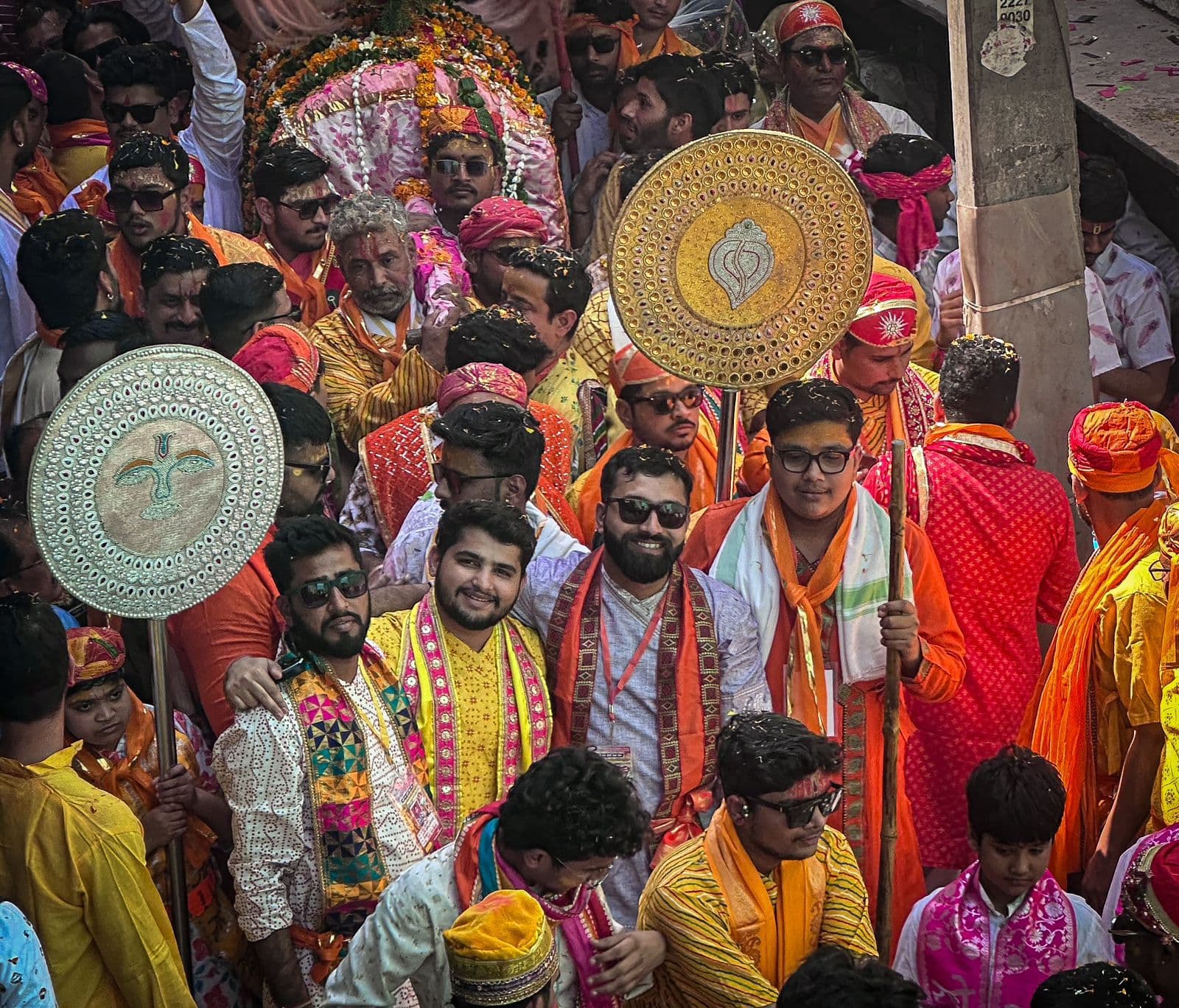
Holi Season | March | 20°C – 32°C | Vrindavan's Holi (Lathmar and Phoolon ki Holi) is the grandest in India - book 90 days in advance |
Janmashtami | August | 28°C – 36°C | Lord Krishna's birthday - the single biggest festival; 500,000+ visitors over 2 days |
Summer | April – June | 38°C – 47°C | Intense heat; cover all outdoor sites before 9:00 AM and after 5:30 PM; temples maintain cool interiors |
Monsoon | July – September | 28°C – 38°C | Green and atmospheric but humid; ghats may be partially flooded; Janmashtami falls here |
Our recommendation: October–February for a comfortable first visit. For Holi in Vrindavan - the most colour-drenched, joyful festival on earth - book your Vrindavan Tour with Experience My India at least 90 days in advance. Call +91-7302265809, 7300620809 - our Holi slots fill by December for March.
Ground Truth - What Nobody Tells You About Vrindavan
After guiding more than 10,000 pilgrims through Vrindavan since 2014, here is what I - Gurudutt, founder of Experience My India - share with every visitor before they arrive:
1. Most temples close between 12:00 PM and 4:00 PM - with no exceptions. This is the single most common mistake first-time visitors make: arriving at Banke Bihari or Nidhivan at 2:00 PM and finding the gates shut. Plan your full temple circuit for the morning session (5:30 AM – 12:00 PM) and the evening session (4:00 PM – 9:30 PM). The gap is non-negotiable - use it for lunch, rest, or Govardhan Bazaar shopping.
2. Vrindavan has over 5,000 temples - most travel guides list only 10–15. The well-known temples attract the tourists; the lesser-known ones - Gopeshwar Mahadev, Shahji Temple, Radha Damodar - are where you find the atmosphere that Vrindavan is actually famous for. Experience My India builds itineraries that include both.
3. The Banke Bihari crowd on weekends and festival days can exceed 50,000 visitors. On ordinary weekday mornings, Banke Bihari is manageable. On Saturdays, Sundays, Janmashtami, and Holi, the crowd surges to a point where darshan takes 90–120 minutes of queuing. Plan your Banke Bihari visit for a Tuesday or Wednesday morning between 8:00 AM and 9:30 AM.
4. E-rickshaws are the correct transport - not tuk-tuks or taxis. The central lanes of Vrindavan (Old Vrindavan, around Banke Bihari and Keshi Ghat) are too narrow for four-wheeled vehicles. E-rickshaws navigate them and cost ₹10–₹20 per short hop or ₹300–₹400 for full-day hire. Agree on the full-day rate before boarding.
5. Monkeys near Banke Bihari and Nidhivan will grab open food and loose bags. Vrindavan's rhesus monkey population is large and accustomed to humans. Do not carry open food outside temple premises, keep bags zipped and remove sunglasses before entering crowded lanes - monkeys have been known to grab them. This is a practical reality, not folklore.
Conclusion
Vrindavan rewards the pilgrim who prepares. Arrive knowing which temples close at noon, which ghat holds the evening Aarti, which grove to enter quietly, and which morning slot at Banke Bihari beats the crowd - and you will experience the town as it is truly meant to be seen. Miss that preparation, and you will spend half the day waiting outside shut gates or pushing through avoidable queues.
Experience My India has helped more than 50,000 pilgrims navigate Vrindavan's 5,000 temples since 2018, rated 4.5★ by 204+ verified travellers. Our Vrindavan guided tours start from ₹2,999 per person and include AC transport, a local guide and a printed session-wise itinerary.
Ready to plan your Vrindavan yatra?
👉 WhatsApp Us Now — Click to Chat
Or call: +91-7302265809, 7300620809
Jai Shri Krishna 🙏
Gurudutt — Born & Raised in Braj Bhoomi
Guiding pilgrims through Mathura & Vrindavan since 2018 · 50,000+ pilgrims served